Why operators wait for help, and how to cut that wait
Most of the time, help isn’t slow because people don’t care. It’s slow because the right person doesn’t know. Five reasons operators wait, and what to do about each.
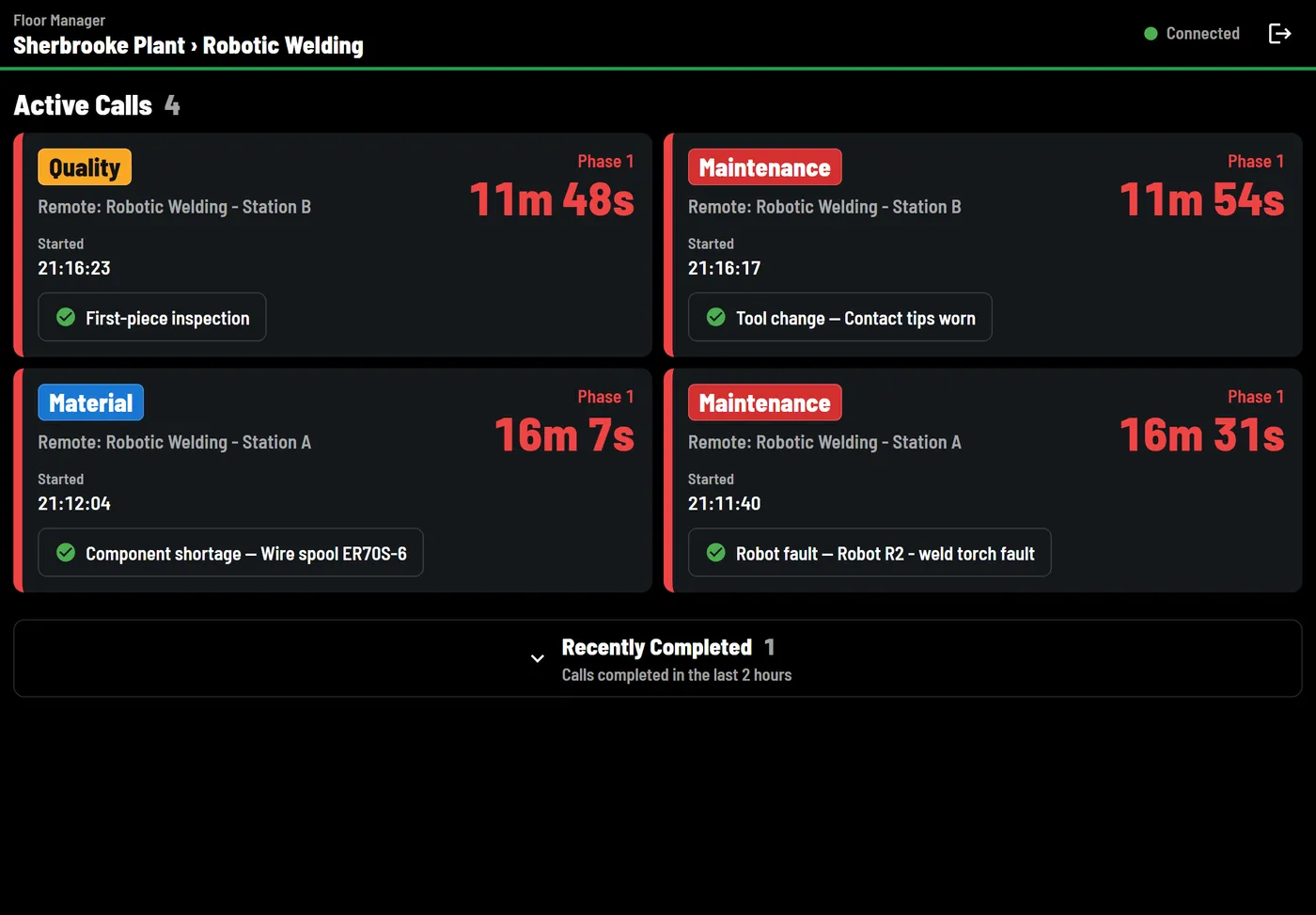
Ask a production manager how long operators wait for help, and you usually get a guess. Ask the operators, and you get a different guess. In most plants nobody really knows, because nobody records it. But the reasons people wait are almost always the same.
1. The operator doesn’t know who to call
Is it a maintenance problem, a quality question or a material shortage? Who’s on shift tonight? When the answer isn’t obvious, the operator goes looking for a supervisor, who then goes looking for the right person. Fix: give each kind of problem its own call type, and send each call type to the right role automatically.
2. The right person doesn’t know there’s a call
They’re at the other end of the plant, in a meeting, or on another job. A light on a machine only helps if someone is looking at it. Fix: put the call where people already look: a board above the line, a supervisor’s tablet, a text message, a Teams notification.
3. Nobody follows up when nobody answers
The call went out, but the responder was busy. Nothing happens next, and the operator waits. Fix: escalation. If a call’s status hasn’t changed after a delay you choose, another contact is told.
4. The operator doesn’t want to bother anyone
This one is real, and it comes up in almost every rollout. Some operators feel that calling for help makes them look bad, or they’ve been told off for calling too often. They try to fix it themselves, or they wait. Fix: make calling normal. Explain that calls are how problems get fixed for good, not a way to grade operators. And make the call take one button, not a trip across the plant.
5. Nobody measures the wait
If waits aren’t recorded, they can’t be ranked, and the same problems keep coming back. Fix: record the time between the call, the response and the fix, automatically. Then look at it by station, by reason and by shift, once a week.
Start small
You don’t need to change the whole plant at once. Pick one line, set up three or four call types, and measure for a few weeks. You’ll learn more about your waiting times in a month than in a year of whiteboards. If you’d like to see how that looks with Andon-SSP, book a 20-minute demo.
Want to see it on your floor?
In 20 minutes, we show you Andon-SSP set up with lines and call types like yours.